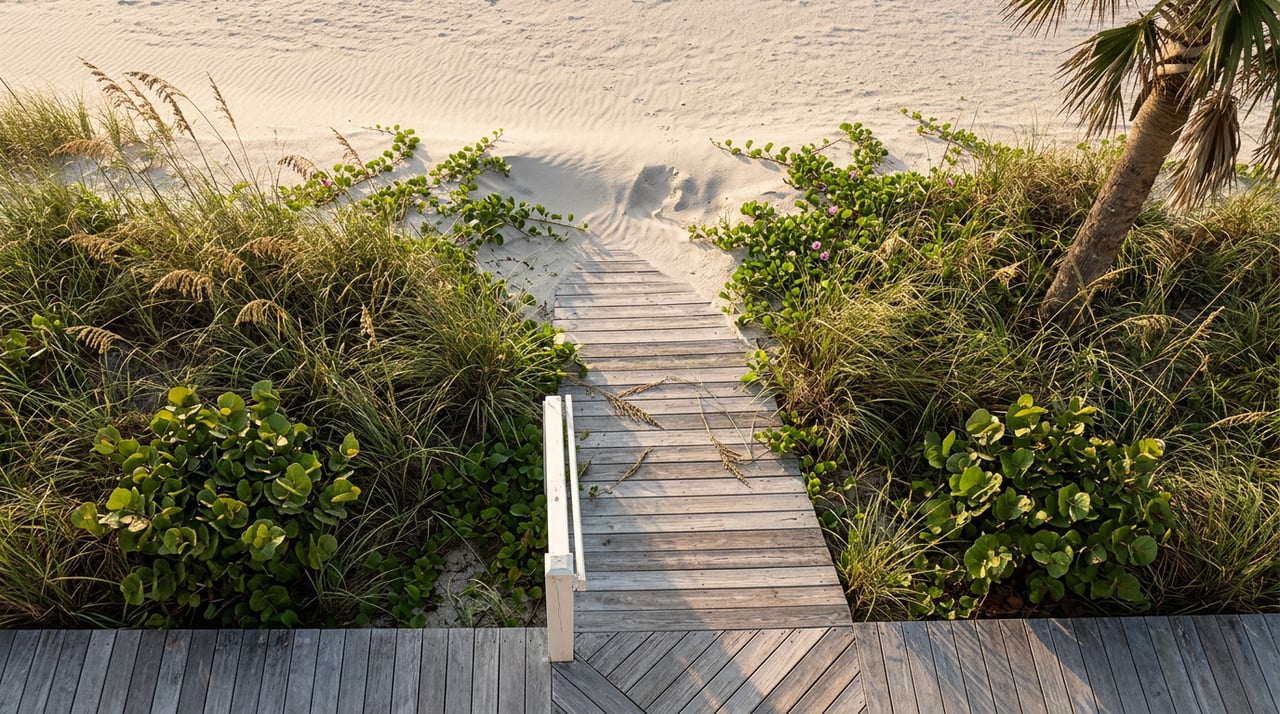
Walk the boardwalk out of Ocean Ridge Hammock Park most evenings this month and you will pass a small rectangle of orange tape staked into the sand, low enough to step over, easy enough to ignore. Most people do. The tape looks like something a permit office forgot to remove. It is not. Someone walked this exact stretch of beach before sunrise, found that patch of disturbed sand, measured it, staked it, and logged it. By the time you step around it on your evening walk, it is already a data point in a running count that says more about this beach than most residents realize.
That count belongs to Sea Turtle Adventures Inc., the volunteer group Jackie Lorne founded in 2016 to patrol roughly three miles of coastline covering southern Ocean Ridge, Briny Breezes, and the Town of Gulf Stream. The group started with seven members. Last year it counted more than 250. Along that same three-mile stretch, the group documented 652 nests in 2025. Set against a town of about 1,880 year-round residents in 2026, that ratio is worth sitting with. Last year's nest count alone equaled more than a third of the town's entire population, logged along a beach most people walk past without noticing.
A Stretch That Doesn't Follow the Map
Here is the part most residents miss, because it is easy to assume the group patrolling "your" beach only patrols your town. It does not. The three miles Sea Turtle Adventures monitors run through three separate municipalities, and the turtles crawling ashore at night have no sense of where Ocean Ridge ends and Gulf Stream begins. Neither, functionally, does the patrol. Lorne's team logs a nest the same way whether it lands in front of a cottage near Old Ocean Boulevard or a lot two towns south.
That geography explains a detail that would otherwise seem odd. This year's fundraising walk kicked off not at a town hall or a municipal beach pavilion inside Ocean Ridge proper, but at Nomad Surf Shop on North Ocean Boulevard, an address that sits closer to the middle of the patrolled stretch than to any one town's center. The organization is built around the beach itself, not the boundary lines drawn on top of it. If you assumed the nest count you hear about locally belongs strictly to Ocean Ridge, it is worth knowing that the number is really a snapshot of a shared coastline, one your neighbors two towns over are just as invested in.
Reading What's Actually in the Sand Right Now
Sea turtle nesting season here runs from March 1 through October 31, which puts late August past the season's midpoint but well inside its busiest window. Most nests take roughly two months to hatch, so a nest staked in mid to late June is likely emerging right about now, and one logged in July still has weeks to go. That is why an August walk along this beach can show you both ends of the process on the same evening: a fresh, tightly staked rectangle near the dune, and an older one nearby with a visibly caved-in center where hatchlings have already dug out and made their run to the water.
A few things are worth knowing if you want to actually read the sand instead of stepping around it:
- The taped perimeter marks a nest a volunteer has already found and logged, not a guess. Someone measured the crawl and the disturbed sand before roping it off.
- A wooden stake at the center usually carries a laid date, which is how patrollers estimate an expected hatch window without digging anything up.
- A collapsed or sunken patch inside older tape almost always means the nest has already hatched. The depression comes from hatchlings tunneling out, not from erosion or storm surge.
- Wide, tractor-tread-looking tracks leading to and from the water are the mother's crawl marks from the night she came ashore, a separate thing from the nest itself.
None of this requires special access. It is simply what is already happening on a beach most residents walk past without a second look.
Why the Porch Light Habit Isn't Just a Suggestion Here
If you have ever wondered why some neighbors near the beach run amber porch bulbs instead of white ones, or keep blinds shut after dark on the ocean side of the house, that habit traces back to the same season. Florida Fish and Wildlife Conservation Commission guidance on turtle-friendly lighting comes down to three rules: keep fixtures low, keep them shielded from the beach, and keep the bulb itself long wavelength, meaning amber, orange, or red rather than white. White light from a beachfront window can pull a nesting female off course before she lays, and it can send hatchlings crawling toward a porch light instead of the surf.
Palm Beach County has regulated beachfront lighting under its own land development code since 1987, and Ocean Ridge is one of the individual municipalities the state has tracked for years as maintaining a sea turtle lighting ordinance of its own, rather than leaving the rule entirely to the county baseline. In practice that means the amber bulb on a neighbor's lanai and the porch light left dark past sunset are not personal quirks. They are a small, mostly invisible layer of local rule-following that only becomes visible once you know to look for it.
The Two Ends of the Walk
The patrolled stretch has two natural bookends worth knowing if you want to see any of this for yourself. To the north, Ocean Ridge Hammock Park sits behind a shaded trail off North Ocean Boulevard, with a wooden boardwalk crossing the dune to a narrow, largely undeveloped beach. There are no lifeguards and almost no amenities, which is exactly why it stays quiet enough for nesting activity to concentrate there. To the south, Ocean Inlet Park offers a different kind of access, with a jetty and marina open around the clock, popular with anglers and boaters working the inlet rather than turtle watchers, but sitting at the southern edge of the same three-mile zone Lorne's group monitors.
Walking between the two on a still evening, especially this late in the season, is close to the nearest thing this town has to a live scoreboard for what is happening on its own coastline. It also means the beach reads differently depending on where you enter it. Near the hammock park, the sand is narrower and the tape tends to sit closer together. Toward the inlet, the crowd thins out for a different reason, foot traffic from the marina and jetty rather than nesting density, though the same volunteers still walk it every morning.
What's Left of the Season
There are close to ten weeks left before this year's nesting season closes on October 31. That means late nests are still possible, and hatchlings from June and July nests are still making their way to the water on quiet nights right now. The practical ask for anyone out on the beach through the rest of the season is simple. Leave the taped rectangles alone, keep flashlights and phone lights off or pointed down if you are out after dark, and if you come across a hatchling that seems disoriented or stuck, the right move is to call for help rather than pick it up.
None of this is complicated. It is just easy to miss until you know what you are looking at, and once you do, an ordinary evening walk along this stretch of A1A starts to feel a little different.
For those of us who spend our days thinking about what makes this stretch of coast worth the address, the turtle count is one more piece of the answer. Terri Berman and Laura Gallagher live and work along this same coastline, and we are always glad to talk through what makes a particular block of Ocean Ridge, or any of the towns along it, feel like home. Reach out anytime.